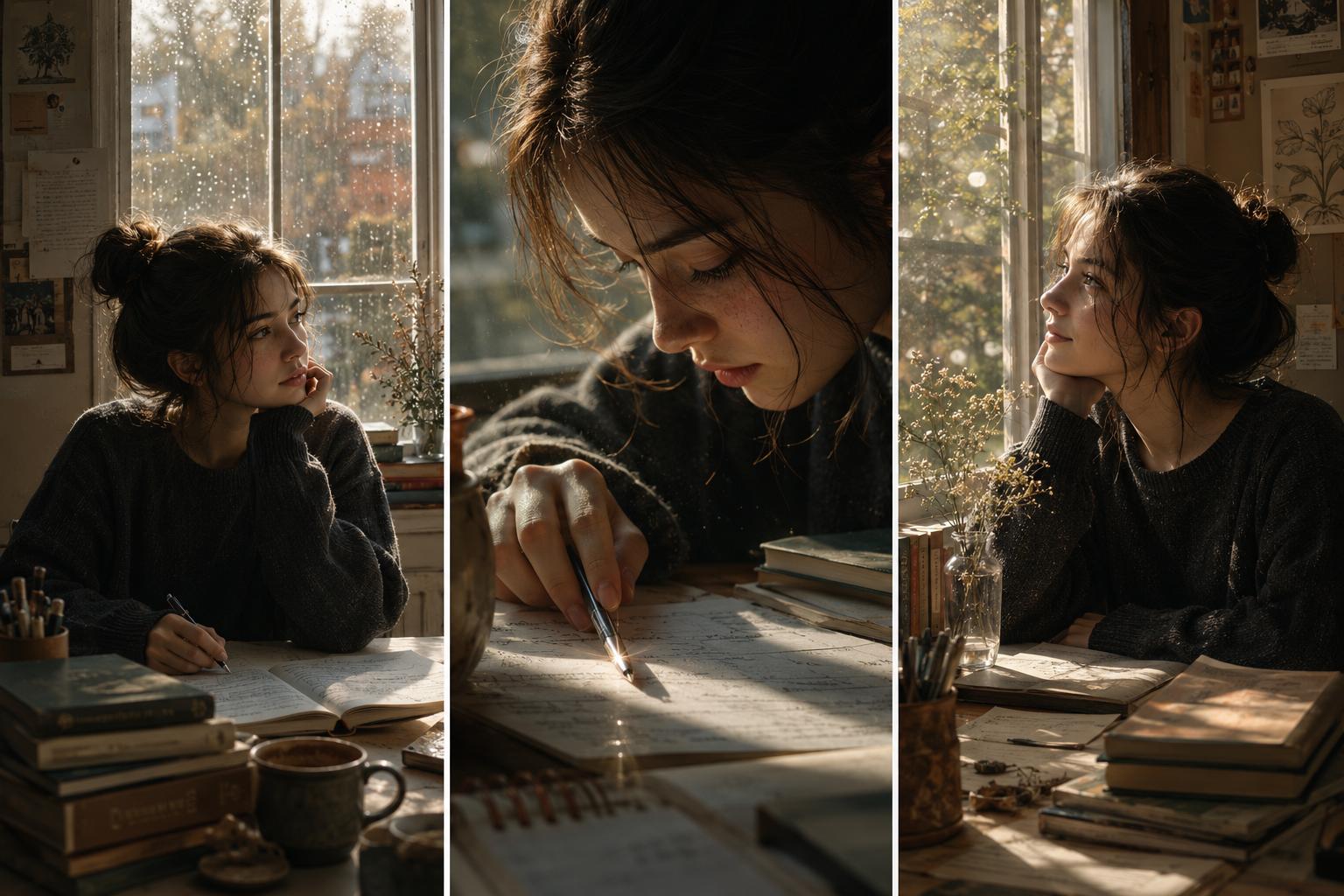
The afternoon sun spilled through Mia’s bedroom window, lighting up the scattered books and pens on her desk. Outside, raindrops lingered on the glass, catching light in tiny, glimmering arcs. The house was quiet; everyone else had stepped out. For once, she could simply sit and look, uninterrupted, with nothing demanding her attention.
Mia’s gaze drifted across the familiar scene. The edge of a pen, the slight curl of a page, the delicate shadow cast by a teacup—these were things she had seen countless times, but never truly noticed. Alone, each detail seemed to hold a story. *How long has that teacup sat there?* she thought. *I’ve never seen the shadow stretch that way before.*
Her mind followed the subtle movements in the light and the textures of her books. She noticed the faint smudge on a page, the way the sunlight reflected off the ink, the gentle tilt of a vase. A quiet thrill ran through her chest. It was as though being alone had stretched the world, giving the ordinary an unexpected significance.
She tilted her head, sniffed the faint scent of old paper, and let herself linger on each small observation. Even the soft hum of the radiator, usually background noise, felt like a rhythm accompanying her awareness. The longer she stayed, the more the world opened itself to her—the flicker of a leaf brushing the window, the subtle tilt of a lamp, the play of light on a notebook.
Mia smiled softly to herself. Solitude had not only given her attention but had sharpened it, allowing her to feel the life in things she had previously overlooked. The ordinary had become extraordinary in these quiet moments, and she realized that noticing—truly noticing—could bring a small but profound joy.