The next morning, Clara unlocked the front door of her grandmother’s house.
The key resisted at first. She turned it once, then again, gently but firmly, the way her grandmother had taught her years ago. The lock clicked open with a tired sound, and the door moved inward.
The air inside was still.
It carried the soft mix of dust, old wood, and the faint laundry soap her grandmother had used for as long as Clara could remember. For a moment, Clara stood at the threshold with her hand still on the key, listening to the quiet of the house.
Nothing moved.
And yet the house did not feel empty.
She stepped inside and set her bag near the wall. The floorboard beneath her right foot creaked in the same place it always had. Clara looked down automatically, as if the sound had greeted her before she was ready.
“Practical first,” she murmured.
The words helped.
She opened the curtains in the sitting room. Pale autumn light entered slowly, revealing dust in the air, the shape of furniture beneath sheets, and a stack of boxes she had sent ahead. On the dining table lay labels, tape, a black marker, and a list she had written in the city with neat, controlled handwriting.
Kitchen cupboards.
Papers.
Photographs.
Linen closet.
Books.
The list made the day feel manageable.
Clara began with the papers. Bills, old letters, instruction manuals for appliances that no longer existed. She sorted them into piles. Keep. Recycle. Unsure. Her hands moved steadily. The work was ordinary enough to let her remain calm.
Then came the blankets.
She folded them carefully, one after another, smoothing the corners before placing them in a box. One still smelled faintly of lavender. Clara pressed it down too quickly and closed the cardboard flaps.
By late morning, the house had begun to look less like a home and more like a task.
That should have comforted her.
Instead, it made the silence sharper.
A knock came at the back door just before noon.
Clara found Noah standing there with a small toolbox in one hand and two paper cups of coffee balanced in the other.
“I brought reinforcements,” he said.
She looked at the cups. “For the window?”
“For the person arguing with the house.”
“I’m not arguing.”
“You opened three curtains and made one box surrender. That counts.”
The corner of her mouth lifted before she could stop it.
Noah stepped inside only after she moved aside. He did not look around too much. Clara noticed that and was grateful. Some people entered old houses as if grief were an invitation to inspect everything.
Noah only glanced toward the sitting room and said, “Still smells the same.”
Clara took one of the coffees. “Everyone keeps saying that.”
“Maybe smells are better at loyalty than people.”
He said it lightly, but not carelessly.
She looked away first.
“The upstairs window is stuck,” she said. “The one facing the garden.”
“Stubborn things,” Noah replied. “My specialty.”
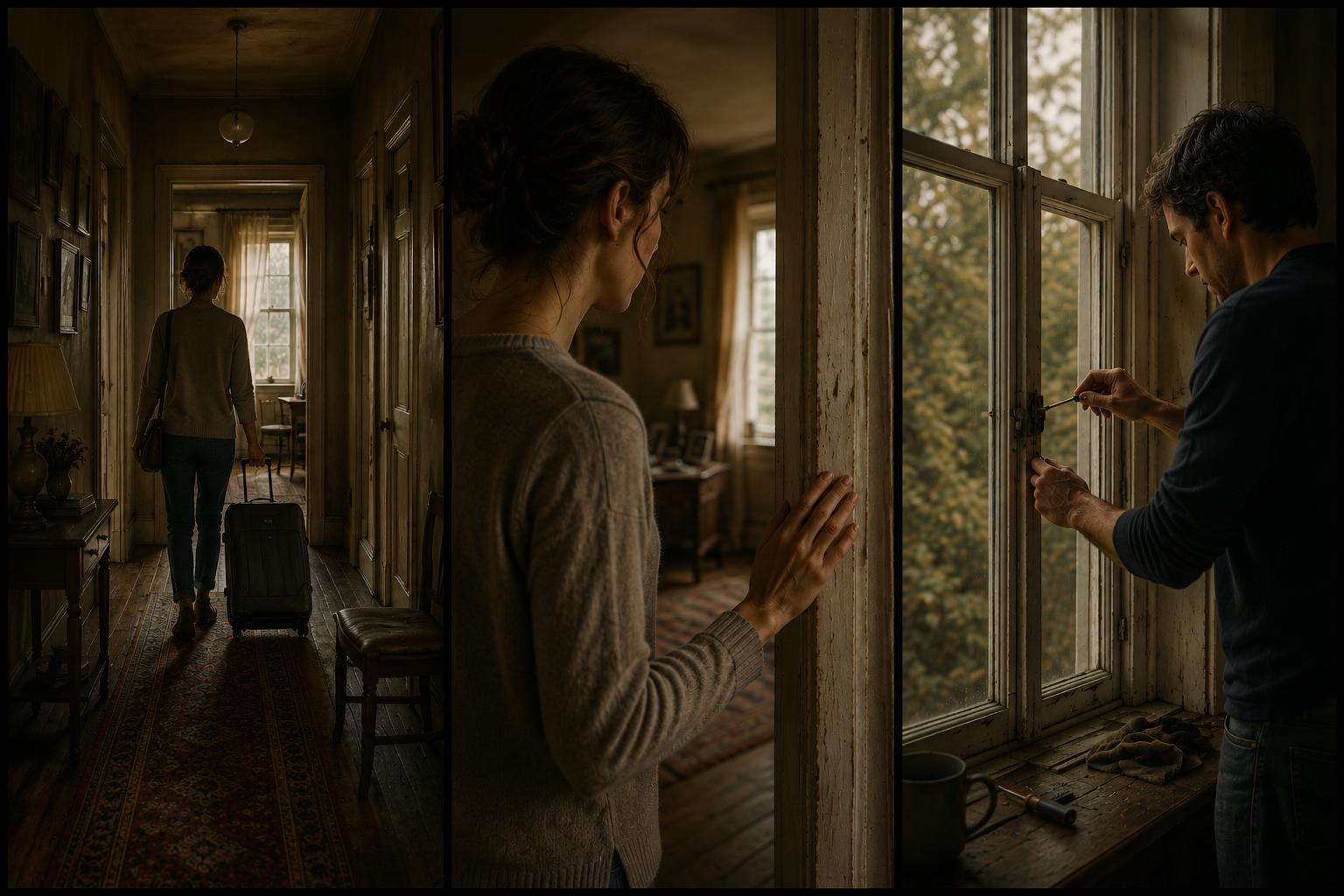
They worked in different parts of the house after that. Clara returned to the dining table. Noah went upstairs, and soon she heard the quiet sounds of tools: a drawer opening, metal placed on wood, the careful scrape of an old window frame being tested.
The noises made the house feel less deserted.
Clara finished one box, then another. She carried a stack of books toward the hallway.
That was when she stopped.
It happened before thought.
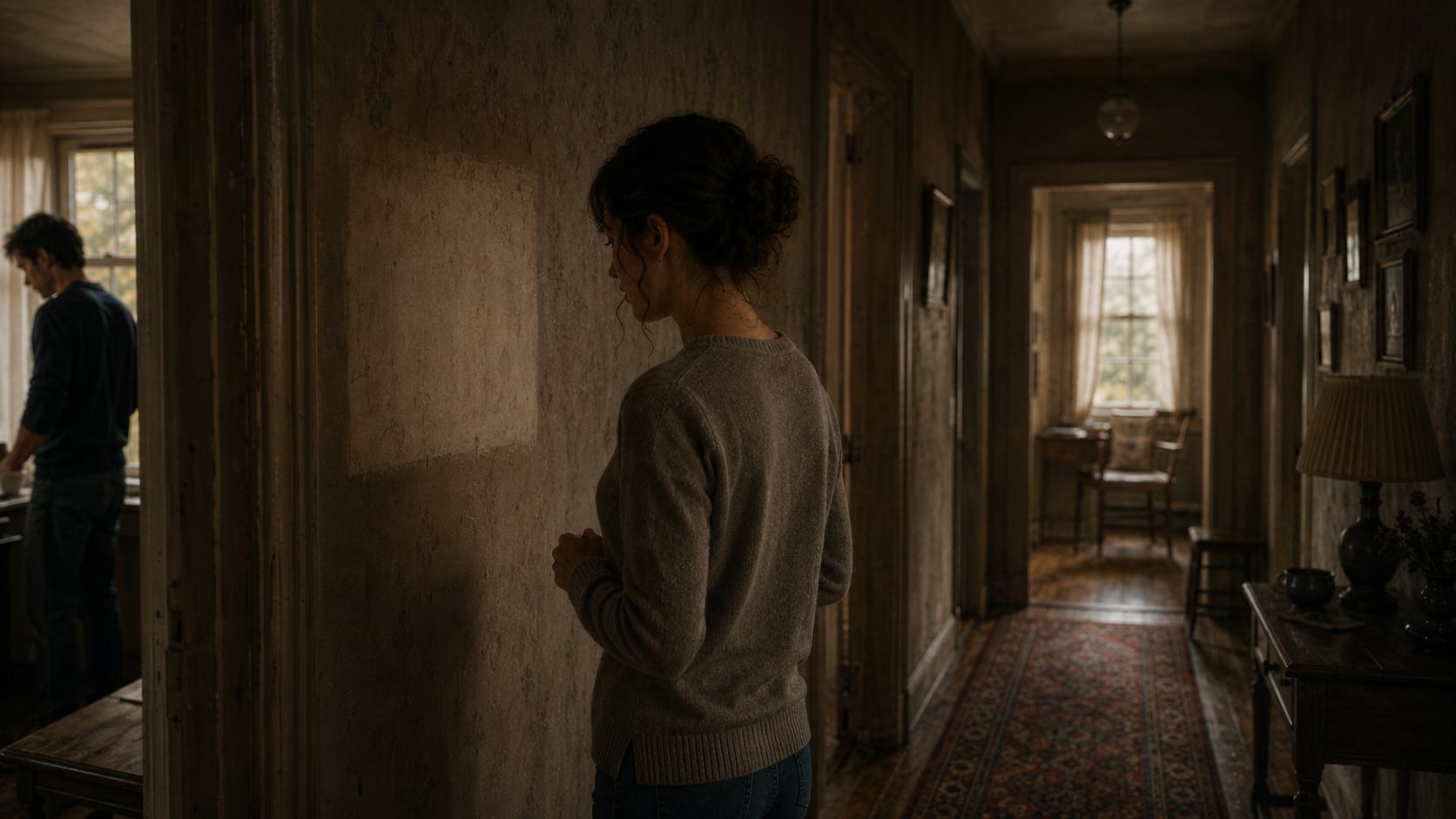
One moment she was walking. The next, she was standing at the entrance to the hallway, her hand resting against the doorframe. The books pressed against her chest. Ahead, the hallway stretched in ordinary silence: narrow, faded, dimmer than the rooms beside it.
There was nothing remarkable there.
Two doors on the left. One door at the end. A worn runner along the floor. A pale rectangle on the wall where a picture had once hung.
Still, Clara did not move.
Her fingers tightened slightly against the wood.
She looked down the hall and felt something rise in her body before it had a name. Not fear exactly. Not sadness exactly. A small resistance, quiet but complete.
Why am I stopping?
The question came clearly.
No answer followed.
From upstairs, Noah called, “This window may have been personally offended sometime in 1987.”
Clara almost laughed, but the sound did not quite reach her.
“I believe it,” she called back.
Her voice sounded normal. That surprised her.
She tried to take a step, but her foot remained where it was. The hallway seemed no longer than before, and yet crossing it felt suddenly difficult, as if the air inside had thickened.
The books grew heavy in her arms.
She placed them carefully on a nearby chair.
Then she touched the faded rectangle on the wall.
The wallpaper there was lighter than the rest, protected for years by a frame that had been removed. Clara remembered the picture now: a photograph of her grandmother standing beside the river, one hand raised to block the sun, laughing at whoever had taken it.
Clara swallowed.
The memory did not arrive all at once. It came in pieces.
A suitcase by the door.
Her own younger voice saying she would call soon.
Her grandmother’s hand smoothing the sleeve of Clara’s coat.
The hallway light flickering once above them.
Clara had been leaving for the city that day. Not forever, she had told herself. Not really. She had been young enough to think distance was simple if you promised to return.
Her grandmother had hugged her in this hallway.
A quick goodbye. A practical goodbye. The kind people use when they are afraid that a slower one might undo them.
Clara remembered pulling away first.
“I’ll be back soon,” she had said.
Her grandmother had smiled and nodded, as if she believed both the sentence and the girl who said it.
But Clara had not come back soon.
Not properly.
Not in time for all the ordinary afternoons she had thought could wait.
The hallway blurred.
Clara lowered her hand from the wall.
Behind her, a floorboard creaked. Noah stood at the far end of the sitting room, not too close, a cloth in one hand.
He did not ask, “Are you all right?”
For that, Clara was grateful.
Instead, he looked down the hall and said softly, “This house has always been stubborn in certain places.”
She let out a breath. It shook once, almost invisibly.
“So you’ve said.”
“I meant the windows,” he said. “But I suppose the house can choose its own methods.”
Clara looked at the faded rectangle again.
“I don’t know why I stopped.”
Noah nodded, as if this did not require immediate correction.
“Maybe you did know,” he said. “Just not in words yet.”
The sentence settled into the hallway with unexpected gentleness.
Clara rested her palm against the doorframe again. The wood was cool and slightly rough beneath her fingers. She thought of her grandmother’s hand on her sleeve. She thought of the promise she had made casually, because she had not understood how quickly years could become distance.
“I said goodbye here,” Clara said.
Noah waited.
“I didn’t know it was the real one.”
Her voice stayed quiet. It did not break. Somehow that made the admission feel more true.
Noah looked toward the window at the end of the hallway, where autumn light rested in a pale square on the floor.
“I don’t think we ever know which goodbyes are the real ones,” he said.
Clara closed her eyes briefly.
The house was silent around them. But the silence had changed. It no longer felt like emptiness. It felt like something listening.
After a while, Noah lifted the cloth slightly. “I can finish the window later.”
“No,” Clara said. “It’s okay.”
And strangely, it was.
Not completely. Not easily. But enough.
She picked up the books again. This time, she stepped into the hallway.
The distance was small: one step, then another. The floor creaked beneath her weight. Light from the far window softened the worn boards. Clara moved slowly, not because she was afraid now, but because she wanted to feel the crossing.
At the end of the hall, she paused once more.
This pause was different.
It did not stop her. It allowed her to arrive.
She turned and looked back. Noah had returned to the window, his movements quiet and deliberate. The house held its dust, its old wood, its stubborn hinges, its memories hidden in ordinary places.
Clara understood then that some memories did not come as pictures or words.
Sometimes they came as hesitation.
Sometimes the body remembered the doorway before the mind was ready to enter it.
And sometimes, stepping through was not a way of leaving the past behind, but a way of finally standing inside it without turning away.