By afternoon, the town had not changed.
That was what Clara kept telling herself.
The bakery was open. The pharmacy sign glowed green at the corner. Cars passed through the square. A child dragged a red schoolbag along the pavement while his mother told him, gently but firmly, to lift it before it wore through. Somewhere, a delivery van reversed with three soft beeps. Someone laughed outside the café.
Nothing was missing.
Still, the day felt quieter than it should have.
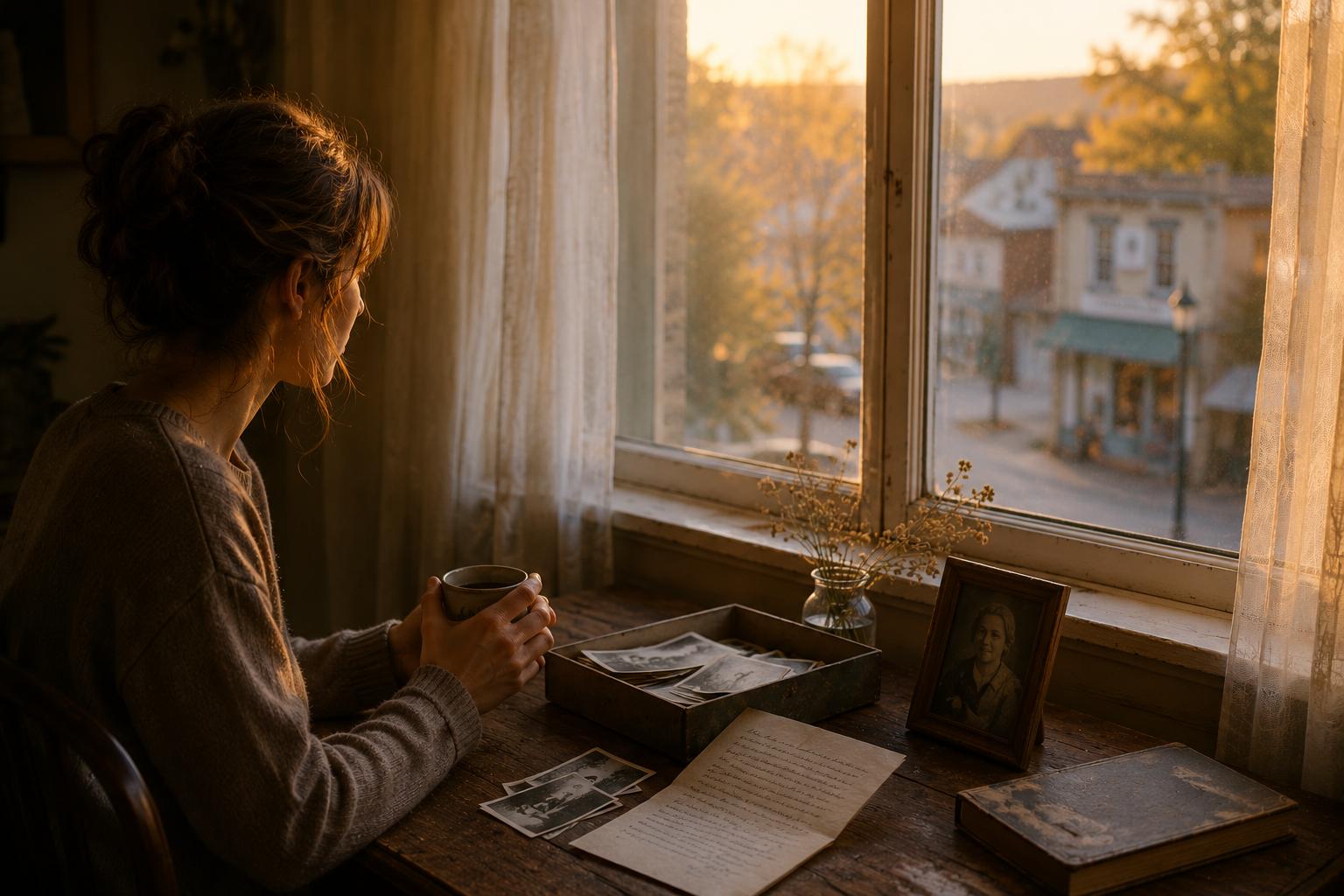
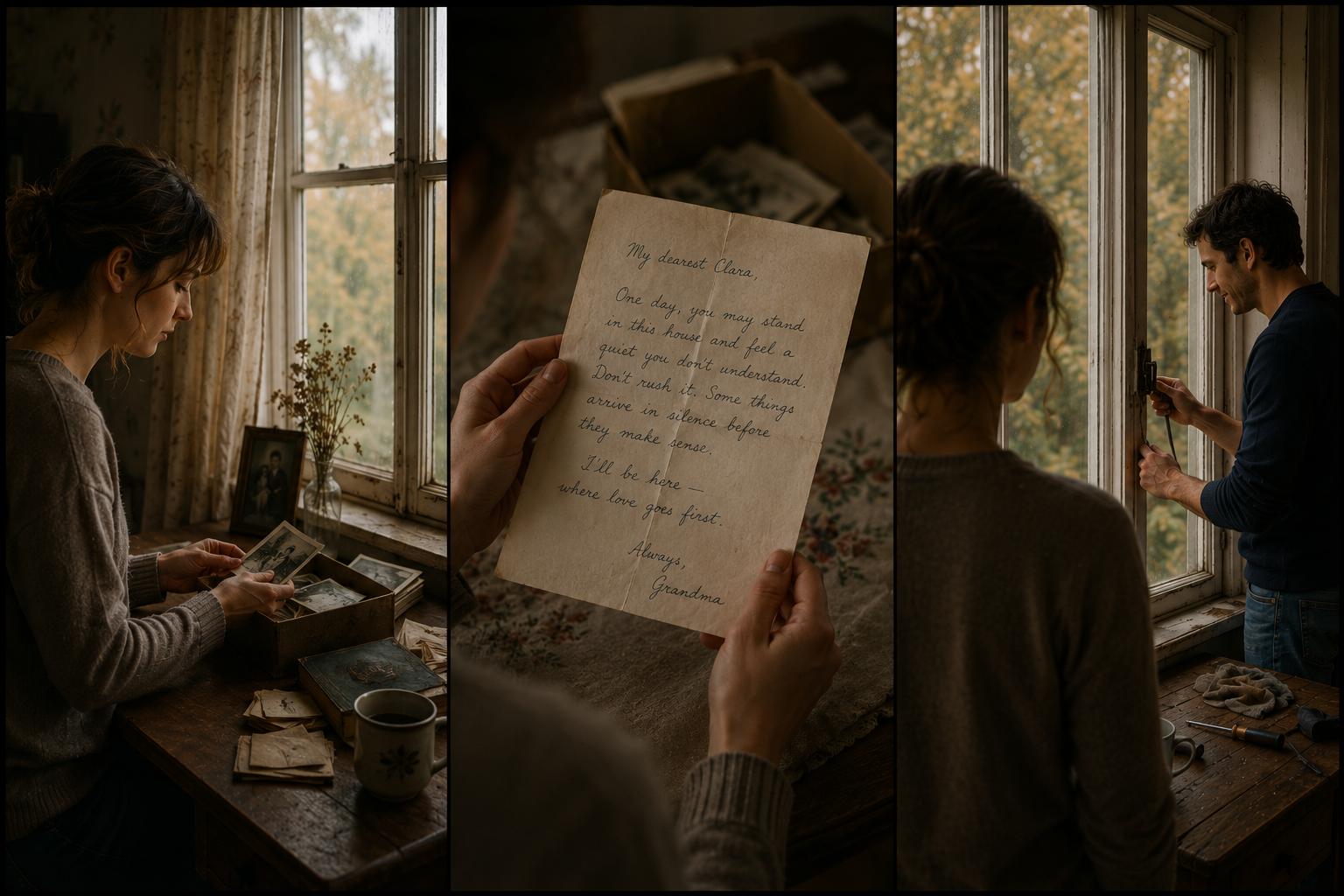
Clara noticed it first while standing in her grandmother’s sitting room, holding a small box of photographs. She had meant to sort them quickly. Keep the important ones, discard the duplicates, place the rest in a folder for later.
But photographs did not behave like bills or instruction manuals.
They resisted categories.
There was one of her grandmother in the garden, sleeves rolled up, looking annoyed at whoever had interrupted her work. One of Clara as a child with jam on her chin. One of Noah at fifteen, standing beside the river with a stick in his hand like a sword, looking both foolish and completely certain of himself.
Clara stared at that one longer than she meant to.
The house was quiet around her, but not peacefully. It was the kind of quiet that made every small sound visible: the scrape of paper, the click of a picture frame settling on the table, the faint shift of leaves outside the window.
She placed the photograph down.
Then she found the letter.
It was folded once, tucked between two old envelopes, the paper softened at the creases. Her name was written on the front in her grandmother’s hand.
Clara did not open it immediately.
For several seconds, she only held it.
The handwriting alone was enough to bring her grandmother close — the slight tilt of the letters, the firm downward stroke on the C, the way the ink faded where her hand must have paused.
Finally, Clara unfolded the page.
My dearest Clara,
One day, you may stand in this house and feel a quiet you don’t understand. Don’t rush it. Some things arrive in silence before they make sense.
I’ll be here — where love goes first.
Always,
Grandma
Clara read it twice.
Then a third time.
The words did not make her cry. Not at first. They did something stranger. They seemed to lower the volume of the room, as if the house itself had leaned closer.
From the kitchen, Noah’s voice called, “I found the window culprit.”
Clara folded the letter carefully. “Was it personally offended again?”
“Worse,” he said. “Paint.”
Despite the ache in her chest, Clara smiled.
Noah appeared in the doorway a moment later, wiping his hands on a cloth. He saw the letter in her hands and stopped, not entering too far into the room.
“Sorry,” he said. “Bad timing?”
“No,” Clara answered.
But she did not say more.
He nodded as if that was enough.
For a while, they stayed in the same room without speaking. Clara placed the letter on the table beside the photographs. Noah looked toward the window, where autumn light gathered in the thin curtains.
“She wrote to me,” Clara said finally.
Noah’s expression softened. “That sounds like her.”
“You knew?”
“That she wrote letters? Yes.” He looked down. “That one? No.”
Clara touched the edge of the paper. “It feels like she knew I would come back too late.”
Noah did not answer quickly.
Outside, a car passed. The sound seemed distant, softened by glass and dust and years.
“I think she knew people come back when they can,” he said.
The kindness in the sentence made Clara look away.
She had expected guilt to come sharply, like accusation. Instead, it arrived gently, which made it harder to refuse. Her grandmother had not blamed her. Noah was not blaming her. The house itself seemed only to be waiting for her to notice what had always been there.
That was the difficulty.
Blame could be resisted.
Tenderness could not.
Later, Noah suggested they walk.
“Fresh air,” he said. “For the house, mostly. It’s been listening too hard.”
Clara looked at him.
He raised both hands. “That sounded less strange in my head.”
“No,” she said. “It’s probably true.”
They left the house by the side door and walked toward the town square. The afternoon had turned gold at the edges. Leaves gathered in shallow drifts near the walls. The town moved as it always had, full of small errands and repeated paths.
Yet Clara felt as if she were walking through a muted version of it.
A woman swept leaves from a shop entrance. Two schoolchildren argued over something important enough to require pointing. The bakery bell rang. A cyclist passed with a bag of groceries swinging from one handlebar.
Everything was ordinary.
Everything felt slightly far away.
Noah walked beside her, hands in his jacket pockets. He did not try to fill the silence too quickly. That was one of the things Clara had forgotten about him. Or perhaps she had never noticed it before. Noah had always known how to let a silence remain without making it uncomfortable.
They reached the riverside path.
The river moved slowly, carrying the afternoon light in broken pieces. Clara remembered this path from childhood: the low stone wall, the uneven roots near the bend, the bench where people sat to look at nothing in particular.
Noah glanced toward the water. “Your grandmother used to come here.”
Clara slowed.
“After I left?”
“Sometimes.”
The word was gentle, but it entered her like a small stone dropped into still water.
“She never told me.”
“She may not have wanted you to feel responsible.”
Clara looked at the river.
The day grew quieter.
Not because sound had disappeared. A dog barked somewhere behind them. A bicycle bell rang near the bridge. The trees rustled above the path. But beneath those sounds was another silence, one Clara had not known how to hear before.
Her grandmother had sat here.
Not every day. Not dramatically. Not waiting at the window like someone abandoned in a story.
Just sometimes.
That was what hurt.
The smallness of it. The ordinariness. The image of her grandmother walking to the river, sitting for a while, then returning home. Carrying love without making it a demand. Missing Clara without turning that missing into accusation.
Clara gripped the folded letter in her coat pocket.
“I thought leaving only happened to me,” she said.
Noah looked at her, but did not interrupt.
“I mean, I knew that sounds selfish. But I thought of it as my life changing. My decision. My distance.” She breathed out slowly. “I didn’t think enough about the life that kept going here.”
Noah leaned his elbows lightly on the stone wall. “Most people don’t. Not while they’re leaving.”
Clara gave a small, tired smile. “Is that meant to make me feel better?”
“A little.”
“Did it work?”
“Not much?”
This time she laughed softly.
The laugh faded into the afternoon, and the quiet returned. But it was different now. Less like emptiness. More like a room finally large enough to hold what had been unsaid.
They walked farther along the river.
Noah told her small things about the town: which shop had changed owners, which teacher had retired, which street flooded every winter no matter how often people complained. Clara listened. The details should have been ordinary, but they felt tender because they belonged to years she had not witnessed.
The town had continued.
Noah had continued.
Her grandmother had continued.
And Clara, elsewhere, had become someone who could now return and feel the shape of what she had missed.
At the bend in the path, they stopped near the old railing. The paint had chipped in several places. Clara remembered leaning there as a teenager, pretending to be bored while secretly hoping the afternoon would never end.
Noah looked out at the water. “She was proud of you, you know.”
Clara closed her eyes for a moment.
“I know,” she said.
But she realized, as she said it, that knowing something was not the same as having received it.
The letter in her pocket seemed warmer than paper should be.
They stood without speaking.
The silence between them did not feel awkward. It did not ask to be filled. It sat there like a third presence — not heavy, not light, but honest.
Clara thought of the house. The hallway. The faded rectangle on the wall. The photographs. The letter. The bakery smell. The river.
All of it seemed connected now, not by explanation, but by a quiet thread running through the day.
Some days felt quieter, she thought, because something inside had stopped defending itself.
The town had not gone silent.
She had simply begun to hear what it carried.
When they finally turned back, the late afternoon light had softened further. Noah walked beside her, close enough to be present, far enough not to press. Clara found comfort in that distance.
At the edge of the square, the bakery bell rang again.
This time, Clara did not feel startled by the memory it carried.
She only listened.
And the sound, bright and small, entered the quiet day without disturbing it.