The bus was seven minutes late.
Clara knew this because she had already checked the timetable twice, then the clock on her phone, then the timetable again, as if the printed numbers might have changed out of sympathy.
They had not.
The old bus stop stood at the edge of the square, just beyond the bakery and the pharmacy, where the road dipped slightly before turning toward the station. Its green paint had chipped along the bench. The plastic timetable cover was cloudy at the corners. A narrow line of rust marked one of the metal posts, darkened by last night’s rain.
Clara sat with her suitcase beside her knees.
The house was no longer hers to prepare.
The papers had been signed that morning at a small office above the bank. The man who handled them had spoken gently, but the words still sounded too clean for what they meant. Sale agreed. Completion date. Remaining contents. Final confirmation.
Final.
The word had followed her out of the office and into the square.
Now she waited.
Seven minutes should have been nothing. Clara had waited longer for trains, for dentists, for delayed appointments, for coffee machines that blinked without explanation. Usually, waiting was a space to fill. She answered messages. Checked the weather. Rearranged lists. Looked busy enough to avoid feeling suspended.
But this morning there was nothing left to arrange.
The suitcase was packed. The keys had been returned. The house had been locked behind her.
So the wait opened.
A bicycle bell rang at the corner.
A bird landed near the curb, hopped twice, then tilted its head toward a crumb too small for anyone else to notice. Across the square, the bakery door opened, releasing a brief warmth into the street. Clara could not smell the bread from where she sat, but she imagined it anyway, and the imagining was almost enough.
Autumn light rested softly on the pavement.
She looked down at the bench.
Someone had scratched initials into the wood years ago. One letter had faded until it was almost unreadable. Clara traced the groove lightly with her thumb.
She wondered how many people had sat here while trying not to feel something too soon.
A car passed slowly. Somewhere behind her, a shopkeeper lifted a metal shutter. The sound rolled across the square and disappeared.
Then she saw Noah.
He came from the direction of her grandmother’s house, walking quickly but not running, one hand tucked into his jacket pocket and the other holding a small cardboard box.
Clara stood before she meant to.
“I thought I’d missed you,” he said when he reached her.
“The bus is late.”
“Good,” he said, then seemed to realize how that sounded. “I mean—not good for public transport. Good for me.”
That made her smile.
He held out the box. “You forgot this.”
Clara looked at it. “I thought we cleared everything.”
“So did I. It was behind the old sewing basket.” He hesitated. “I didn’t look through it properly.”
She took the box from him. It was light, the cardboard soft at the corners.
The bus did not come.
Clara sat again, and after a moment, Noah sat beside her, leaving a small space between them. Not too close. Not distant.
The kind of space they had learned over two days.
Inside the box were a few photographs, a folded handkerchief, two buttons in a paper envelope, and a small tin that had once held mints. Clara opened the tin carefully.
There was a photograph inside.
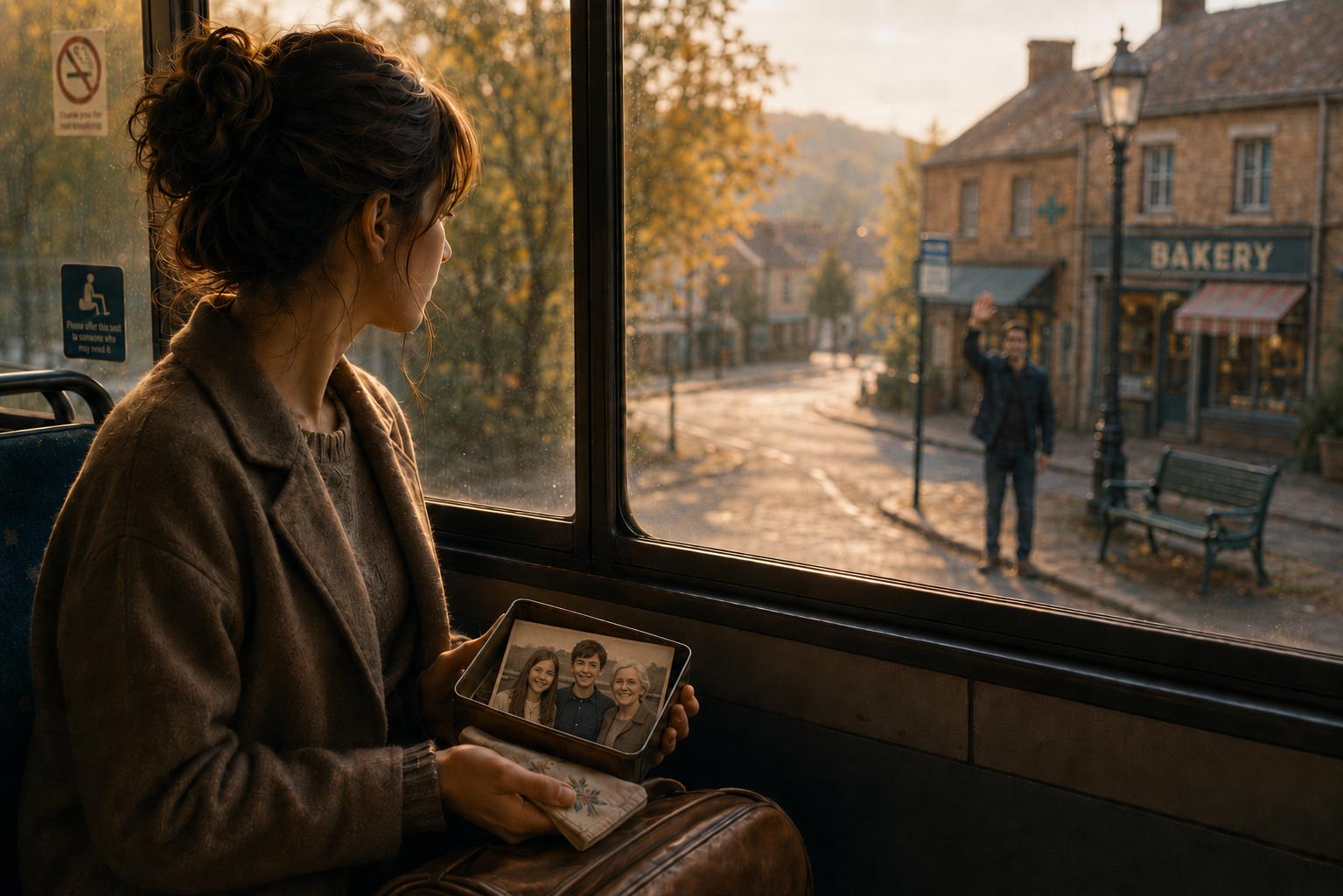
Three figures stood near the riverside: Clara at thirteen, Noah beside her, and her grandmother between them, one hand on each of their shoulders. The sky behind them was pale. Clara had a crooked fringe she had clearly cut herself. Noah was smiling too widely. Her grandmother looked directly at the camera, amused and steady, as if she were the only one who knew how quickly such moments would become precious.
Clara stared at it for a long time.
Noah leaned forward slightly, enough to see but not enough to intrude.
“Oh,” he said softly. “That day.”
“You remember?”
“You tried to convince everyone you could row a boat.”
“I could row a boat.”
“You rowed in a circle for ten minutes.”
Clara laughed once, quiet and surprised.
Then the laugh thinned.
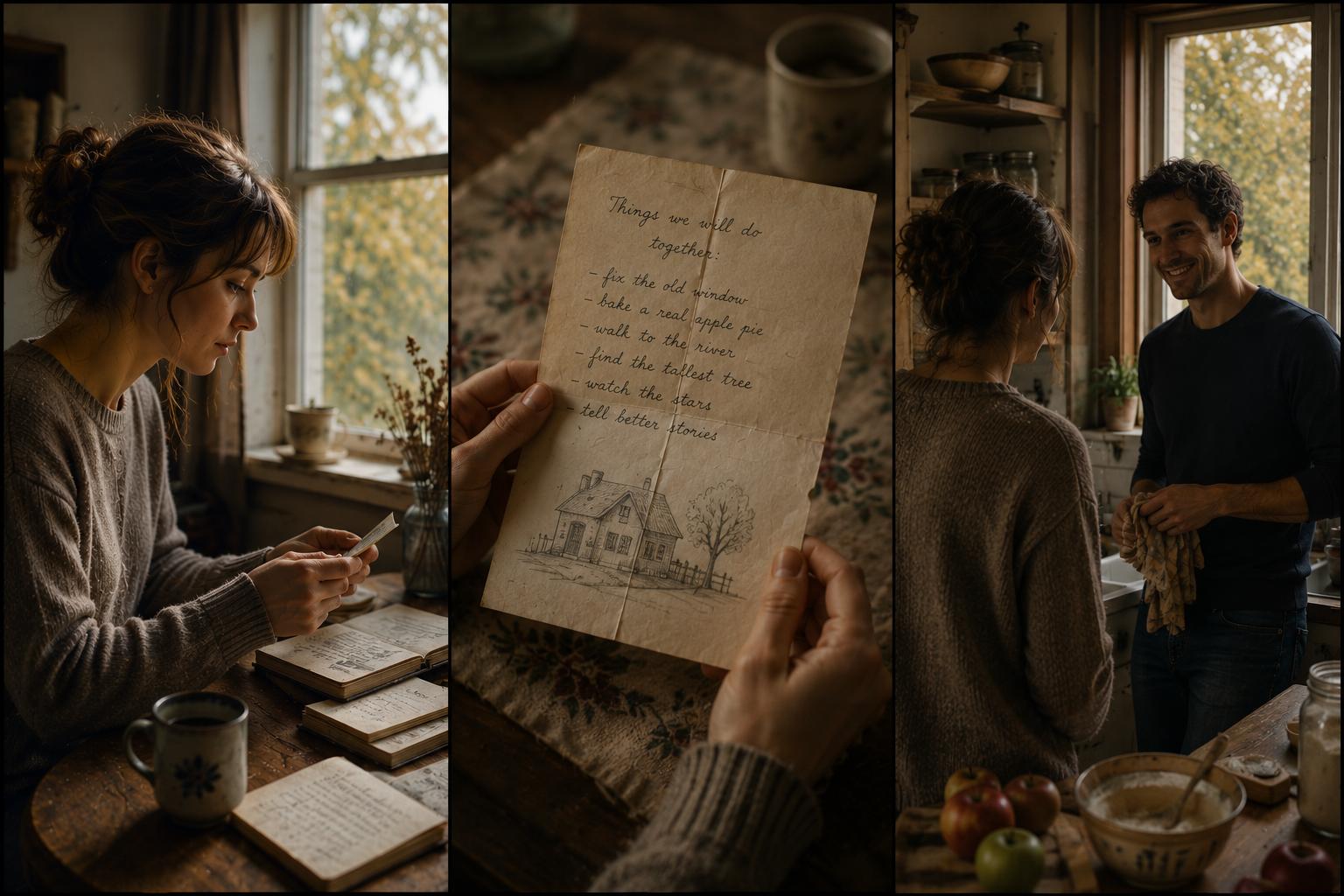
Her thumb rested against the edge of the photograph. She thought of the riverside path, the hallway, the bakery smell, the letter, the window Noah had finally managed to open. She thought of all the ordinary things that had seemed to be waiting in the town, not with accusation, but with patience.
The bus was still not there.
For once, Clara did not mind.
She looked at the photograph until the faces stopped feeling like evidence of something lost and began to feel like proof that it had existed. That was different. Softer.
“I kept thinking,” she said, “that coming back would make everything final.”
Noah looked toward the road. “Did it?”
Clara considered the question.
Across the square, someone came out of the bakery carrying a paper bag. The brass bell rang behind them, bright and small. The sound reached Clara clearly.
“No,” she said. “Not exactly.”
Noah nodded.
She closed the tin and held it in both hands.
“I think I was afraid that if I remembered too much, I wouldn’t be able to leave again.”
“And now?”
The bus appeared at the far end of the road, turning slowly past the pharmacy.
Clara watched it approach.
Now, she thought, the remembering was already here. It had entered through bread and dust and paper and silence. It had stood in the hallway before she understood it. It had walked beside her by the river. It had sat down with her in this small, inconvenient wait.
And somehow, it had not broken her open.
It had only made more room.
“I think leaving is different when I don’t have to pretend I’m empty-handed,” she said.
Noah did not answer immediately. His eyes stayed on the approaching bus.
“That sounds true,” he said.
The bus slowed beside the stop with a tired sigh. Its doors opened.
Clara remained seated for one extra moment.
Noah did not tell her to hurry.
She looked at the town square: the bakery window, the pharmacy sign, the bicycles near the railing, the wet shine of the road, the ordinary morning moving forward without needing her permission.
Then she looked at Noah.
“Thank you,” she said.
“For the box?”
“For not asking too quickly.”
His smile was small. “You looked like someone who needed people to wait properly.”
Clara held the tin closer.
A few days ago, the sentence might have made her look away. Now it only settled quietly inside her.
She stood, pulling her suitcase upright.
Noah stood too.
Neither of them promised anything. She did not say she would come back soon. He did not ask her to. They had both become old enough to know that promises made at departures could sometimes be too heavy for the people who wanted to believe them.
Instead, Noah said, “Take care, Clara.”
She nodded. “You too.”
Then, after a pause, she added, “I’ll write.”
He smiled, gently enough that the words did not become a performance. “I’ll read.”
Clara stepped onto the bus.
She found a seat by the window and placed the small box on her lap. Through the glass, Noah stood beside the old green bench, one hand in his jacket pocket, the other raised slightly in farewell.
The bus pulled away.
The square moved past slowly at first: bakery, lamppost, pharmacy, the corner where the road bent out of town. Clara watched until the shapes began to loosen into distance.
In her lap, the tin warmed beneath her hand.
She thought of her grandmother’s letter.
Some things arrive in silence before they make sense.
Outside, the town slipped behind the trees.
Clara did not feel that leaving meant disappearing.
Not this time.
She leaned back against the seat, the photograph safe inside the box, and let the road carry her forward. A few leaves followed the bus for a moment, lifted by its passing, then settled gently back onto the pavement.
Behind her, the town grew smaller.
Inside her, it did not.